
How can I avoid getting stuck with high insurance rates due to my health history?
How a mobile underwriting health assessment can replace blunt risk classes with personalized pricing, giving applicants with a health history a fairer rate.
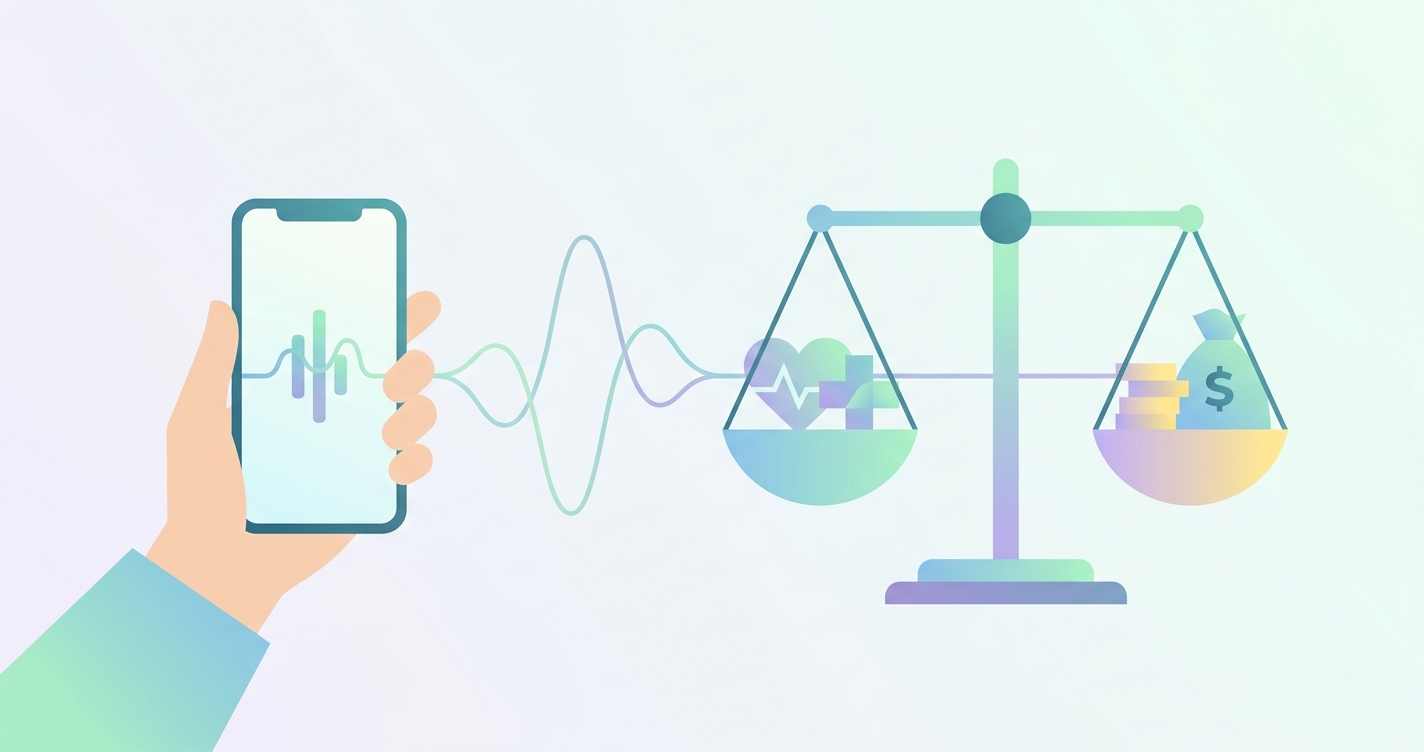
Most people who fear high insurance rates assume their health history is a single, permanent verdict. A diagnosis from years ago, a family pattern of heart disease, or one elevated lab value gets filed away and quietly priced in for the rest of a policy's life. That assumption is becoming outdated. A mobile underwriting health assessment, where an applicant captures live physiological signals from a phone camera in under a minute, gives carriers current evidence of how a person is actually doing today, not just what a record said about them in the past. For applicants worried about being stuck with a bad rate, that shift from static history to present-tense data is the most consequential change in underwriting in a generation.
A 2024 LexisNexis Risk Solutions study analyzing roughly 50 million individuals from 2018 to 2022 found that combining medical and non-medical data lets some applicants in traditionally high-risk groups, including those with Type 2 diabetes or asthma, qualify for accelerated underwriting that older models would have flagged.
The core problem is that traditional underwriting compresses a complex human being into a handful of risk classes. If your file contains a condition code, you fall into a bucket, and that bucket carries a price. The bucket does not know whether your condition is well managed, whether your resting heart rate and respiratory patterns look healthy, or whether you have spent three years rebuilding your fitness. A mobile underwriting health assessment narrows that gap by adding fresh, measured signals to the file.
Why a mobile underwriting health assessment changes the pricing math
Underwriting has always been an exercise in reducing uncertainty. The less a carrier knows, the more conservatively it prices, and conservative pricing punishes the applicant who looks risky on paper but is healthy in reality. When a mobile underwriting health assessment supplies live data, the carrier can replace a worst-case assumption with an observation. That is the mechanism behind personalized pricing: more accurate inputs produce narrower, fairer outputs.
Smartphone photoplethysmography (PPG), the contactless technique behind most phone-based scans, reads subtle color changes in the skin to estimate cardiovascular signals. A 2024 real-world validation study published through the National Institutes of Health reported that a smartphone PPG application detected atrial fibrillation with 98.3 percent sensitivity and 99.9 percent specificity. Researchers have also shown that deep learning models can estimate biological age from smartphone-acquired PPG with a mean absolute error of about 8.1 years, a signal directly relevant to mortality risk. These are not laboratory curiosities anymore; they are inputs an underwriting engine can act on.
The table below contrasts how the same applicant is treated under three approaches.
| Dimension | Traditional paramedical exam | Records-only accelerated path | Mobile underwriting health assessment |
|---|---|---|---|
| Data freshness | Point-in-time blood draw, scheduled weeks out | Historical claims and prescription records | Live physiological capture, current to the second |
| Time to complete | Days to weeks | Minutes, but no new health signal | About 30 seconds from the applicant's phone |
| Treatment of past conditions | Often penalized via blunt risk class | Inferred from old codes | Re-evaluated against present-day vitals |
| Applicant friction | High (nurse visit, fasting) | Low but opaque | Low and transparent |
| Personalized pricing potential | Moderate | Limited by stale data | High, current signal sharpens segmentation |
For an applicant, the practical implications come down to a few points:
- A current healthy signal can offset an older flag, supporting reconsideration rather than automatic loading.
- Capturing data yourself removes the scheduling delay that lets an upcoming birthday raise your age-based rate.
- Objective measurement reduces reliance on memory and self-report, which protects honest applicants.
- More granular data lets carriers create finer pricing tiers instead of lumping dissimilar risks together.
Industry applications for fairer pricing
Reconsideration and post-issue repricing
Carriers increasingly let policyholders request a rate review after a health improvement. A mobile underwriting health assessment makes that review cheap enough to offer at scale. Instead of mailing a customer back to a clinic, the carrier sends a link, captures fresh vitals, and feeds them to the same engine that priced the original policy. For someone who controlled their blood pressure or lost significant weight, this turns a vague promise of future savings into a repeatable process.
Expanding the accelerated underwriting pool
Munich Re's Fall 2024 Accelerated Underwriting survey described a maturing market where carriers keep raising eligibility limits and adding digital health data tools. The constraint on these programs has always been confidence: a carrier will only waive the exam if the alternative data is strong enough. Adding a live physiological scan strengthens that alternative, letting more applicants, including some with a managed health history, stay on the fast, no-exam path rather than being kicked into full underwriting.
Reaching underserved and substandard segments
The Gen Re 2024 U.S. Individual Life Accelerated Underwriting survey of 38 carriers identified reducing time to issue and meeting consumer expectations as top program goals. Applicants with health histories are precisely the group most often lost to long, intrusive processes. A phone-based assessment lowers the cost of evaluating them accurately, which makes it commercially viable to write business that carriers previously declined or priced defensively.
Current research and evidence
The evidence base supporting contactless assessment has strengthened quickly, but it carries real caveats that underwriting teams should weigh.
On the supportive side, meta-analyses of smartphone PPG for heart rate monitoring have found close agreement with validated reference methods in adults at rest, and the 2024 atrial fibrillation validation cited above shows clinical-grade performance is achievable in real-world settings. RGA's published work on PPG solutions for insurance describes how the technique can digitally assess heart rate, respiratory rate, oxygen saturation, and related signals to augment underwriting without a physical exam.
On the cautionary side, researchers consistently flag limits. A 2024 Frontiers scoping review of resting heart rate from contact-based smartphone PPG stressed that signal validity depends heavily on acquisition conditions, and called for standardized capture and reporting protocols. Known error sources include motion artifacts, sensor placement, and variation across skin tone and body mass index. Notably, Munich Re's 2024 work found that wearable physical-activity data has not yet gained much traction in risk classification, with only about 7 percent of companies evaluating it, a reminder that adoption of any new signal moves carefully through actuarial validation before it touches price.
The honest reading is that mobile assessment is mature enough to improve segmentation and reconsideration today, while full standalone replacement of fluids for large face amounts remains a work in progress. For applicants, the immediate benefit is that this data can help, rather than hurt, when it shows a healthy present.
The Future of mobile underwriting health assessment
Three trends will shape the next few years. First, multimodal scoring: combining live PPG-derived vitals with prescription, claims, and EHR data, which the 2024 LexisNexis study identified as the most protective inputs, to produce risk estimates that no single source could deliver. Second, continuous and on-demand underwriting, where pricing is no longer a one-time gate but something a policyholder can revisit whenever their health improves. Third, regulatory attention to fairness, as insurance departments examine how algorithmic inputs affect different populations, which will push vendors toward documented validation across diverse groups.
For the applicant worried about a health history, the direction of travel is favorable. The industry is moving from a model that assumes the worst when data is missing toward one that measures the present and prices it. The data signal will not erase a serious condition, but it changes the default from suspicion to evidence.
Frequently asked questions
Can a phone health scan actually lower my insurance rate if I have a health history? It can support a more accurate, and sometimes more favorable, decision. A mobile underwriting health assessment adds current physiological data to your file. When that data shows you are healthy now, it gives the underwriter evidence to reconsider a blunt risk class rather than defaulting to a conservative, higher price. It is not a guaranteed discount, but it removes the penalty of being judged only on old records.
Is the data from a 30-second scan reliable enough for underwriting? Peer-reviewed studies in 2023 and 2024 show smartphone PPG can match validated methods for measures like resting heart rate and detect atrial fibrillation with high accuracy. Reliability depends on good capture conditions, which is why quality checks and retries matter. Carriers typically use the scan alongside records data rather than as the only input.
Does sharing a health scan put my privacy at risk? Reputable programs disclose what is captured, how it is used in underwriting, and how long it is retained. Because a contactless scan does not require blood or a clinic visit, some applicants find it less invasive than a paramedical exam, though you should always review the carrier's consent and data-retention terms before scanning.
Will my old diagnosis automatically disqualify me? Less often than it used to. The 2024 LexisNexis analysis found that combining medical and non-medical data let some people with conditions like Type 2 diabetes qualify for accelerated underwriting. A current healthy signal from a mobile assessment can help shift the evaluation from automatic loading toward genuine reconsideration.
Circadify is building toward this fairer, evidence-first model, replacing the nurse visit with a 30-second self-scan that gives carriers current data and gives applicants a chance to be priced on who they are now. Insurance product leaders and underwriting teams can explore product demos and integration guides at circadify.com/industries/payers-insurance.