
How can I check my health for insurance from home with no needles?
How no-needle digital health assessment insurance works, why applicants prefer it, and how insurtechs can position non-invasive screening for broader reach.
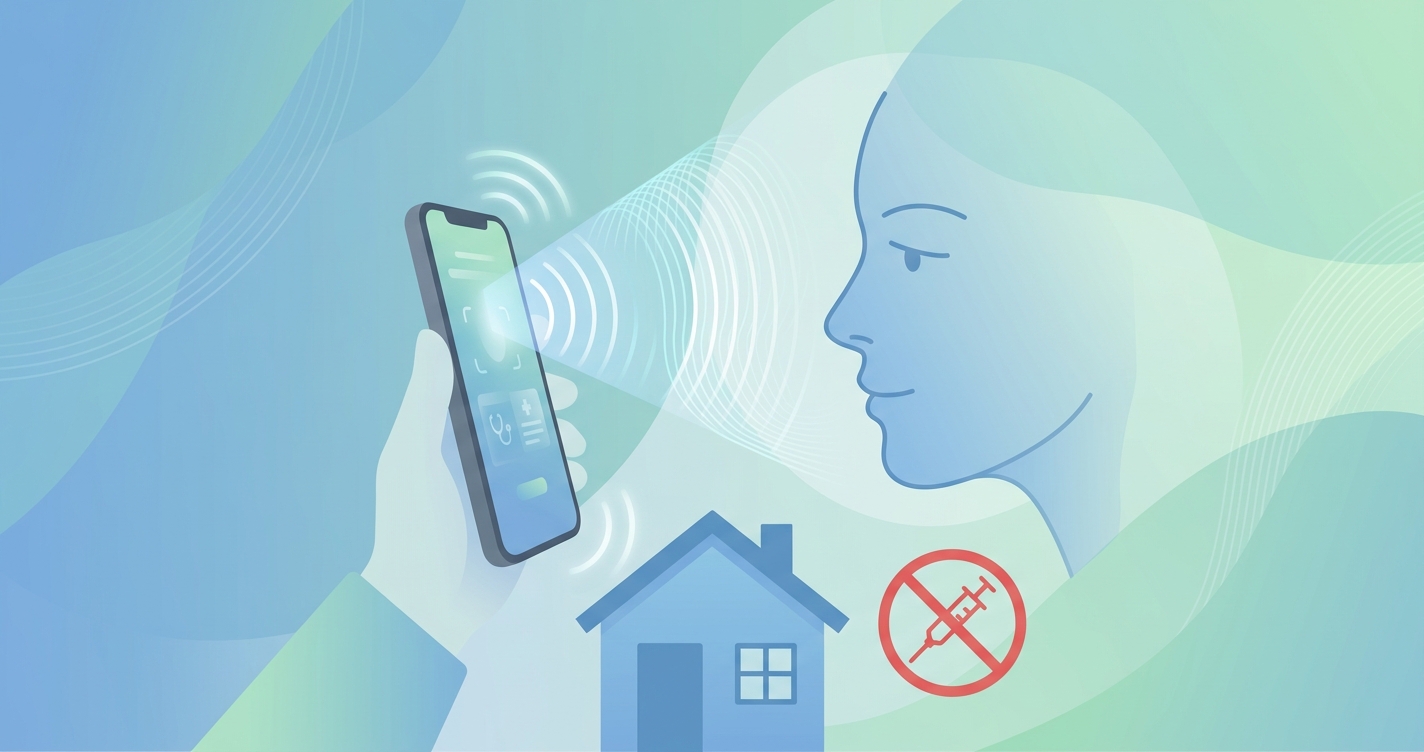
For most of the last century, proving you were healthy enough for life insurance meant one thing: a stranger arriving at your kitchen table with a blood-draw kit, a urine cup, and a blood pressure cuff. That ritual, the paramedical exam, is now optional for a growing share of applicants. A no-needle digital health assessment insurance workflow lets someone check their health from home using nothing more than a smartphone camera, answering the practical question buyers keep asking: can I really qualify without anyone drawing blood? Increasingly, the answer is yes, and the shift carries strategic weight for insurance product managers and insurtechs deciding how to position non-invasive screening to a wider market.
In Gen Re's 2024 U.S. Individual Life Accelerated Underwriting Survey, 82% of carriers reported a fully or partially implemented accelerated underwriting workflow, and the average program made 66% of applicants eligible for a path that skips traditional fluid collection.
What a no-needle digital health assessment insurance check actually involves
A digital health assessment insurance check replaces fluid-based testing with two data streams that together approximate the signal underwriters historically pulled from blood and urine. The first is a contactless vitals scan. Using remote photoplethysmography (rPPG), a phone or laptop camera detects micro-changes in skin color caused by blood flowing beneath the surface. From a 30-second face or fingertip capture, the software estimates heart rate, heart rate variability, respiratory rate, and in some implementations blood pressure proxies. The second stream is structured data: digitized health questions, identity verification, and third-party records such as prescription histories, medical claims, and motor vehicle reports.
The applicant experience is the part that matters most for adoption. Instead of scheduling an appointment, taking time off work, and waiting days for lab results, the person points a camera at their face, answers a short questionnaire, and submits. No needles, no nurse, no specimen shipping. For carriers, the underwriting signal arrives in minutes rather than the multi-week cycle a paramedical exam imposes.
Here is how the no-needle model compares with the traditional approach across the dimensions that influence both conversion and underwriting confidence.
| Dimension | Traditional paramedical exam | No-needle digital health assessment |
|---|---|---|
| Data collection | Blood draw, urine sample, BP cuff, in-person | Camera-based vitals scan plus digital questionnaire |
| Applicant time commitment | Scheduling plus 30-45 min visit | Self-serve, roughly 5-10 minutes total |
| Typical decision turnaround | Up to 23 days for full underwriting | Minutes to a few days |
| Location | Home or clinic, by appointment | Anywhere with a phone and internet |
| Drop-off risk | High at scheduling and visit stages | Lower, but sensitive to scan UX |
| Cost per applicant | Lab fees, examiner fees, logistics | Software-driven, lower marginal cost |
| Best-fit segments | High face amounts, complex risk | Simplified issue, mid-market, term, final expense |
The takeaway is not that one method wins outright. It is that the friction profile of the no-needle path opens segments the exam model priced out or scared away.
Why applicants prefer the no-needle path
The convenience story is obvious, but the data points to deeper reasons applicants gravitate toward non-invasive checks:
- Needle aversion is widespread. A meaningful share of adults delay or avoid medical procedures specifically because of fear of blood draws, which removes a real barrier when screening goes contactless.
- Scheduling friction is eliminated. The paramedical visit forces coordination between an examiner and the applicant, a step where many applications stall and never resume.
- Privacy feels more controllable. Completing a scan alone at home reads as less intrusive than welcoming a stranger into one's house.
- Speed matches expectations set elsewhere. Consumers who open bank accounts and verify identity in minutes find multi-week underwriting hard to tolerate.
For the buyer side, these preferences translate into measurable funnel improvements. The same survey data showing 82% workflow adoption also reflects why carriers keep expanding eligibility: faster, lower-friction screening pulls more applicants through to a decision.
Industry applications for insurers and insurtechs
The no-needle model is not a single product. It is a capability that maps differently onto different lines of business, and positioning it well requires matching the technology to the segment.
Simplified and accelerated issue
This is the natural home for camera-based assessment. According to Munich Re's 2024 analysis of U.S. accelerated underwriting trends, roughly 47% of individual life applications were eligible for accelerated, non-automated underwriting and 12% for fully automated decisioning. A non-invasive vitals scan strengthens these paths by adding a physiological signal that pure data-only models lack, without reintroducing fluid collection.
Mid-market and underserved segments
The structural opportunity is reach. LIMRA's 2024 Insurance Barometer Study found roughly 102 million American adults believe they need life insurance or need more of it. Much of that gap sits in mid-market households for whom the exam process is a deterrent rather than a safeguard. A no-needle check lowers the cost and effort of distribution enough to make these policies economically viable.
Conversion and cross-sell campaigns
Carriers running term conversion, mortgage protection, or final expense campaigns face customers who already have a relationship but resist re-screening. Embedding a 30-second scan into a renewal or upgrade flow removes the single biggest reason these campaigns underperform: the exam.
Rural and remote distribution
Where paramedical examiner networks are thin, scheduling can take weeks. A phone-based assessment functions identically whether the applicant lives in a city center or 90 minutes from the nearest clinic, extending addressable market without added logistics cost.
Current research and evidence
The credibility of no-needle screening rests on whether camera-derived vitals hold up against clinical references. The evidence base has matured quickly. A 2023 clinical validation study published in PMC evaluated rPPG-enabled contactless pulse rate monitoring in cardiovascular disease patients and reported a mean absolute error of 1.061 beats per minute and a Pearson correlation of 0.962 against electrocardiography, strong agreement in a clinically complex population. Broader reviews, including a 2024 Frontiers analysis of rPPG for health assessment, describe consistent accuracy for heart rate and respiratory rate, with blood pressure estimation still the harder problem and an active area of model development.
The honest position, which underwriting leaders should adopt openly, is that contactless vitals are well validated for some measures and emerging for others. Researchers consistently flag two challenges: reliability across skin tones and lighting conditions, and performance on irregular rhythms. Deep learning approaches are improving robustness on both fronts, but the responsible framing positions camera-based vitals as one input within a layered underwriting model, not a one-to-one replacement for every lab value.
It is worth being precise about scope. A blood panel measures things a camera cannot see directly, such as cholesterol, glucose, and nicotine metabolites. The no-needle model compensates by combining vitals with prescription, claims, and behavioral data. The underwriting question is not whether a scan equals a blood draw, but whether the combined non-invasive signal supports a sound risk decision for a given segment and face amount.
The future of no-needle health checks for insurance
Three trends will shape the next phase. First, eligibility limits keep rising. Gen Re's 2024 survey noted maximum accelerated underwriting face amounts reaching up to $2.5 million, meaning non-invasive paths are no longer confined to small policies. Second, the data layer will deepen as carriers blend camera vitals with longitudinal records and consented wearable data, sharpening risk segmentation. Third, regulatory attention to algorithmic fairness will intensify, making demographic validation of vitals models a competitive requirement rather than an afterthought.
For product managers, the positioning lesson is to lead with the applicant benefit and back it with disciplined evidence. The phrase that resonates with the market is not technical accuracy alone; it is no needles, no nurse, no waiting. The carriers that win will be those that pair that promise with transparent benchmarking and a clear view of which segments the model serves best today.
Frequently asked questions
Can I really get life insurance without any blood test? For many policies, yes. A growing share of carriers offer accelerated or simplified issue paths that use a non-invasive digital health assessment, combining a camera-based vitals scan with health questions and third-party records instead of a blood draw. Eligibility depends on age, coverage amount, and health history.
How does a phone camera measure my health without touching me? It uses remote photoplethysmography, which detects tiny color changes in your skin caused by blood flow. From a short video of your face or fingertip, software estimates vitals like heart rate, heart rate variability, and respiratory rate. Studies have shown strong agreement with clinical heart rate references.
Is a no-needle assessment as accurate as a lab test? It depends on the measure. Camera-based heart rate and respiratory rate are well validated, while some metrics like blood pressure are still maturing. A blood panel still captures values a camera cannot, so insurers pair vitals with prescription and claims data to support sound decisions for the right segments.
Why are insurers moving toward no-needle screening? It removes major friction. Applicants avoid needles, scheduling, and multi-week waits, which improves completion rates. For carriers, decisions arrive in minutes rather than up to 23 days, and lower screening costs make previously unprofitable mid-market segments viable.
Circadify is building in this space, developing non-invasive, camera-based health assessment technology designed to fit into modern underwriting workflows. Insurance product managers and insurtechs evaluating no-needle screening can explore product demos and integration guides at circadify.com/industries/payers-insurance.