Will my heart be strong enough for life insurance without a doctor's visit?
How remote cardiovascular screening and the modern insurance applicant health check estimate heart risk without a nurse visit, and what the evidence shows.
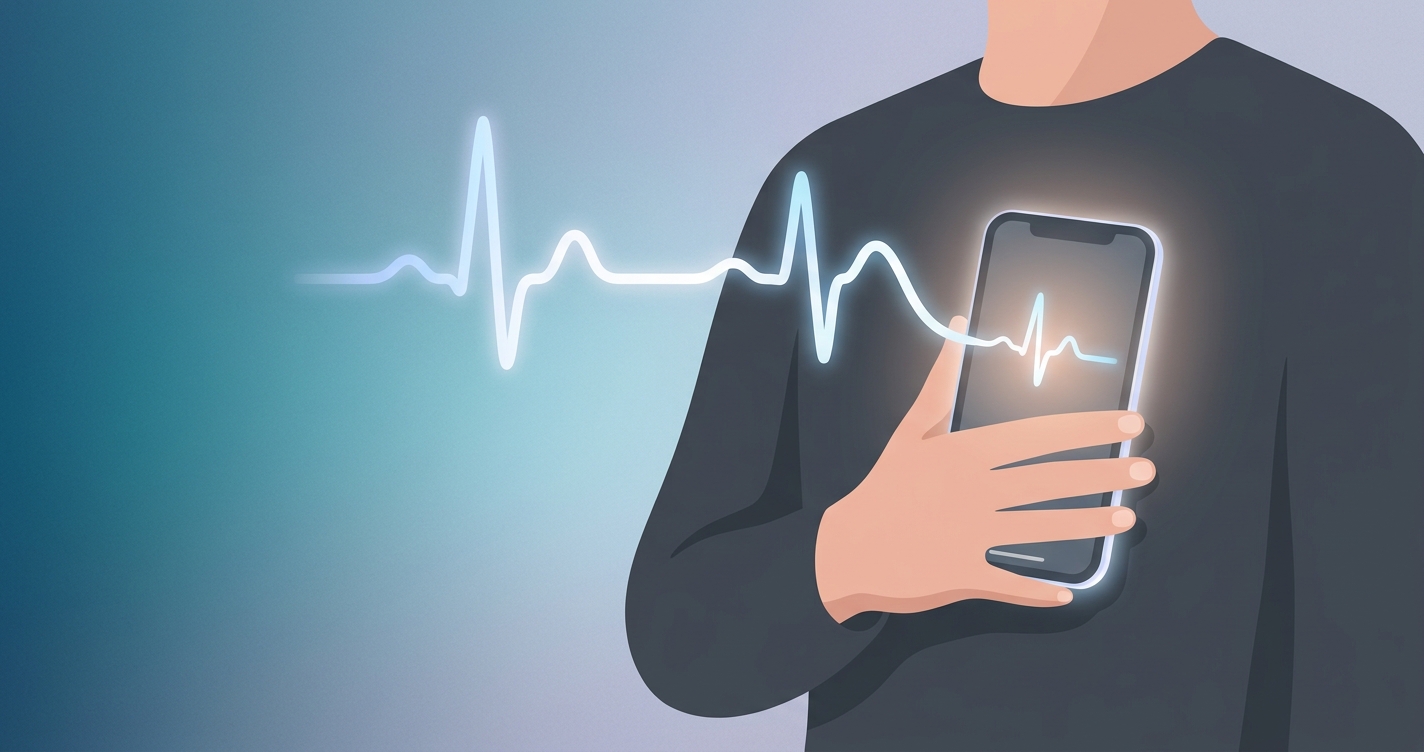
When an applicant wonders whether their heart is strong enough to qualify for life insurance without ever seeing a doctor, they are really asking two questions at once. The first is personal: is my cardiovascular health good enough to pass. The second is structural: can a 30-second phone scan actually judge that as well as a nurse with a blood pressure cuff. For insurance product managers and underwriting teams, the second question is the one that matters, because it determines whether a digital insurance applicant health check can replace the paramedical exam without quietly degrading mortality experience. The honest answer is that remote cardiovascular assessment has moved from speculative to measurable, and the data now exists to evaluate it on its own terms.
A deep learning cardiovascular risk score built from smartphone photoplethysmography reached a C-statistic of 71.1%, statistically non-inferior to an office-based clinical risk score at 70.9%, when validated on 54,856 UK Biobank participants (Google Research and partners, PLOS Global Public Health, 2024).
What an insurance applicant health check actually measures for the heart
The phrase insurance applicant health check covers a wide range of methods, and conflating them is the most common analytical mistake. A traditional paramedical exam measures blood pressure, height, weight, and draws blood for lipids, glucose, and biomarkers such as NT-proBNP. A digital cardiovascular assessment does something different. Using photoplethysmography, or PPG, a phone camera detects subtle color changes in the skin caused by blood volume shifts with each heartbeat. From that signal, algorithms estimate heart rate, heart rate variability, pulse waveform characteristics, and increasingly a modeled cardiovascular risk band.
The critical point for underwriters is that a digital scan is not trying to reproduce a lab panel value by value. It produces a risk stratification signal. The relevant question is not whether a scan can report a cholesterol number, but whether the signal it produces sorts applicants into mortality-relevant tiers with enough discrimination to inform a decision. That reframing changes how accuracy should be judged.
- A scan estimates physiological signals, not laboratory chemistry.
- The output is most useful as a risk band, not a single diagnostic number.
- Discrimination, measured by the C-statistic, matters more than point-value agreement.
- Calibration, whether predicted risk matches observed events, is the second pillar.
Comparing the methods on the metrics that matter
The table below compares the three approaches an applicant might encounter, framed around the attributes underwriting teams weigh when redesigning a flow.
| Attribute | Paramedical exam + blood | Remote PPG cardiovascular scan | Self-reported questionnaire |
|---|---|---|---|
| Time to complete | 30-45 min plus scheduling | About 30 seconds | 5-10 min |
| Placebo for fraud | Low, supervised draw | Liveness checks reduce spoofing | High, disclosure-dependent |
| Cardiovascular signal captured | Direct biomarkers, BP, lipids | Heart rate, HRV, pulse waveform, risk band | None measured, only recalled |
| 10-year MACE discrimination | High with full panel | C-statistic ~71% in published study | Limited, depends on honesty |
| Drop-off / abandonment | High, scheduling friction | Low, completed on phone | Moderate |
| Cost per applicant | $75-150 typical | Fraction of exam cost | Lowest |
| Best fit | Large face amounts, complex risk | Simplified and accelerated tiers | Triage and pre-fill |
No single method wins on every axis. The exam still carries the most direct cardiovascular biomarker depth, which is why it persists at high face amounts. The remote scan wins decisively on completion rate and cost, while delivering risk discrimination that, in published research, approaches office-based clinical scoring.
Industry applications of remote heart screening
Accelerated and simplified issue underwriting
Accelerated underwriting already approves many applicants in days rather than weeks. LIMRA data indicates that more than half of American consumers say they are more likely to buy life insurance when no medical exam is required, and the share of carriers operating or planning accelerated programs rose from 62% in 2019 to roughly 91% by 2021. A digital cardiovascular signal fits naturally here as an additional evidence source alongside prescription history, MIB data, and motor vehicle records, helping carriers extend accelerated eligibility without flying blind on heart risk.
Final expense and guaranteed-issue adjacent products
For older applicants in smaller face-amount products, a full exam is rarely economical. A remote heart assessment can introduce a measured cardiovascular signal where today there is often only a yes-or-no health question, improving stratification in a segment that has historically relied on graded benefits and guesswork.
Term conversion and in-force re-underwriting
When a policyholder converts term coverage or requests a better rate class, carriers want a low-friction way to refresh risk. A scan completed from the couch avoids the scheduling burden that causes many such reviews to stall.
Current research and evidence
The strongest recent evidence comes from work published in PLOS Global Public Health in 2024, in which researchers affiliated with Google Research built a deep learning score from smartphone-style PPG signals using age, sex, smoking status, and the waveform itself. Trained on 141,509 UK Biobank participants and tested on a separate 54,856, the model predicted 10-year major adverse cardiovascular events with a C-statistic of 71.1%, non-inferior to an office-based refit-WHO score at 70.9%. Calibration was sound, with a mean absolute calibration error of 1.8%, and adding the PPG features to the office score lifted discrimination by a further 1.0%.
Two findings deserve underwriting attention. First, a passive optical signal carried risk information comparable to a model requiring measured blood pressure and body metrics. Second, the PPG features were additive, meaning they captured signal the clinical variables missed. For a product manager, that suggests remote cardiovascular screening is not merely a cheaper substitute but a potentially complementary data layer.
The caveats are real and worth stating plainly. The UK Biobank skews healthier and less diverse than a general applicant pool, so calibration must be re-validated on each carrier's population. PPG quality varies with skin tone, motion, and camera hardware, which is why liveness and signal-quality gating matter operationally. And a risk band is not a diagnosis, so it informs classification rather than replacing clinical judgment at the extremes.
- Discrimination near clinical scores does not equal biomarker-level diagnosis.
- Population calibration must be re-checked on the carrier's own book.
- Signal quality controls are an underwriting requirement, not an afterthought.
- The strongest deployments treat the scan as one input in a multi-source model.
The future of remote cardiovascular assessment in underwriting
The trajectory points toward layered evidence rather than a single replacement. Munich Re's analysis of accelerated underwriting trends notes that carriers continue expanding eligibility limits and folding in digital health data, and remote cardiovascular signals are a logical extension of that pattern. The NAIC's Accelerated Underwriting Working Group adopted regulatory guidance on external data and analytics in August 2024, which signals that supervisors expect governance, explainability, and fairness testing around any new data source. Carriers that build those controls in early will move faster when remote heart screening becomes a standard tier.
Expect three developments. Risk models will increasingly fuse PPG-derived signals with disclosed history and third-party data to produce a single calibrated mortality estimate. Validation will shift from generic research cohorts to carrier-specific holdout studies that prove discrimination on the actual applicant mix. And applicant experience will become a competitive lever, because a scan that fails on poor lighting or low-end phones quietly reintroduces the friction it was meant to remove.
Frequently asked questions
Can a phone scan really tell if my heart is healthy enough for life insurance?
A phone scan does not diagnose heart disease the way a cardiologist does. It estimates physiological signals such as heart rate, heart rate variability, and pulse waveform, and models them into a cardiovascular risk band. Published research shows this band can discriminate 10-year cardiovascular risk at a level comparable to office-based clinical scores, which is enough to inform underwriting classification for many products.
Will a remote assessment hurt my chances compared to a nurse visit?
For most applicants in good health, a remote insurance applicant health check reduces friction and speeds approval. It is not designed to penalize. At very high face amounts or with complex medical histories, carriers may still require a full exam because direct biomarkers add depth that an optical scan cannot match.
How accurate is digital cardiovascular screening for underwriting?
In a 2024 UK Biobank validation, a smartphone-style PPG risk score reached a C-statistic of 71.1%, statistically non-inferior to a clinical office-based score at 70.9%, with strong calibration. Accuracy depends on signal quality and on re-validating the model against each carrier's own population.
Does the scan replace blood work entirely?
Not always. The scan is best understood as one evidence source within a multi-input model. For simplified and accelerated tiers it can stand in for the exam, but high-value or higher-risk cases may still trigger traditional blood work.
For insurance product managers evaluating where remote cardiovascular screening fits into an underwriting roadmap, the practical work is validation, governance, and applicant experience design rather than waiting for the technology to mature. Circadify is building toward this space with a phone-based self-scan intended to slot into accelerated and simplified flows. To review product demos and integration guides, visit circadify.com/industries/payers-insurance.