
Insurance Applicant Health Check: How to Handle Edge Cases and Retries
When digital health screenings fail or produce unusable data, what happens next? A look at edge case management, retry logic, and the operational realities of insurance applicant health checks.
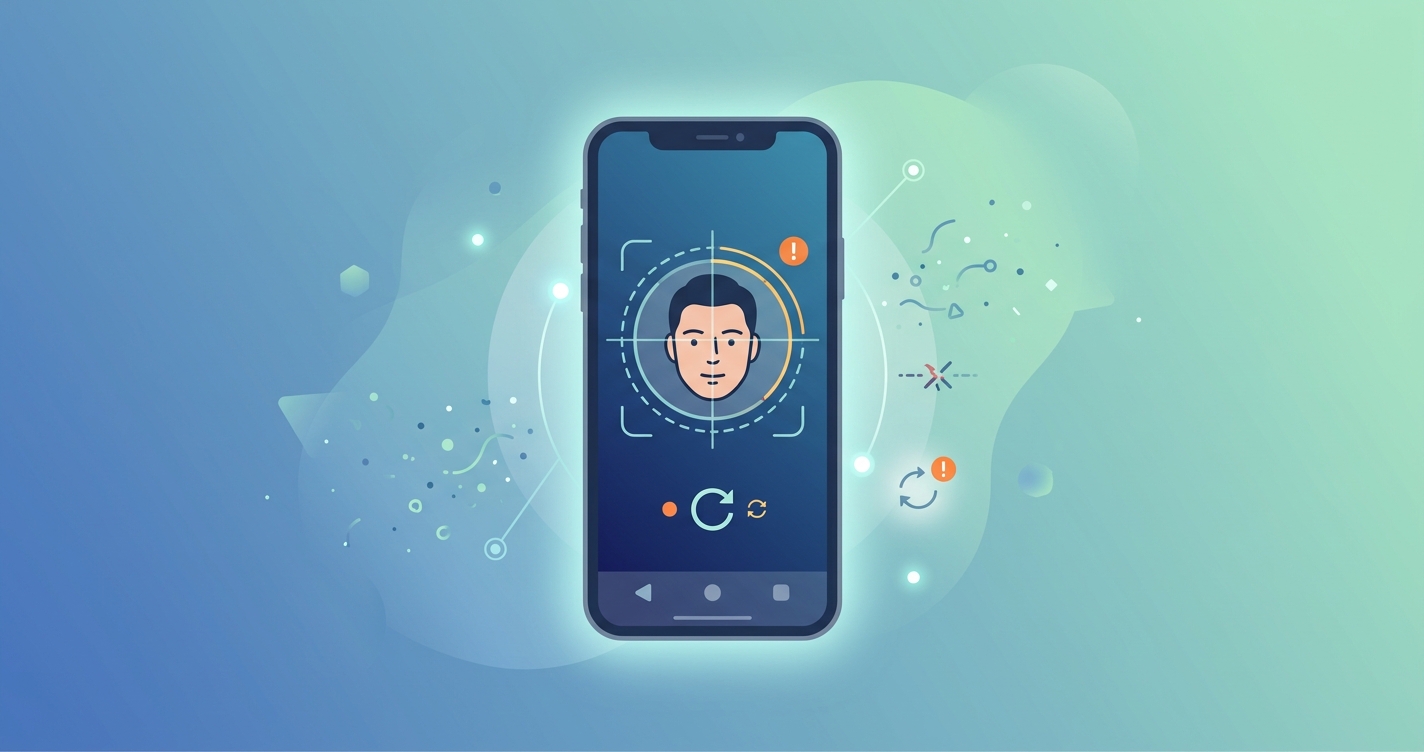
Insurance applicant health check edge cases are the unglamorous reality behind every digital screening program. The demos always work perfectly. The pitch decks show a smiling applicant holding their phone up, getting instant results. But anyone who has actually deployed a camera-based biometric screening at scale knows the truth: a meaningful percentage of sessions do not produce clean data on the first attempt. The applicant was in a dark room. They moved too much. Their phone camera was smudged. The WiFi dropped mid-scan.
A 2025 review in Frontiers in Digital Health examining remote photoplethysmography (rPPG) methodology found that ambient lighting conditions, subject motion, and camera sensor quality were the three most significant factors affecting signal reliability. None of these are under the insurer's control once the applicant starts scanning from their own device.
Where digital health checks actually break down
The failure modes in digital health screening fall into predictable categories. Understanding them matters because each one requires a different operational response. A lighting problem calls for user guidance. A device incompatibility requires a fallback pathway. A network interruption needs session recovery. Treating them all the same way leads to frustrated applicants and wasted underwriting spend.
Here is what carriers and platform operators typically encounter:
| Edge Case Category | What Happens | Frequency (est.) | Typical Resolution |
|---|---|---|---|
| Insufficient ambient lighting | rPPG signal too noisy to extract reliable vitals | 8-12% of sessions | Real-time feedback prompting applicant to move to better-lit area |
| Excessive subject motion | Head movement or hand tremor corrupts the signal | 5-8% of sessions | Session pause with stabilization coaching; retry from last clean segment |
| Low-quality front camera | Older devices lack resolution or frame rate for rPPG | 3-5% of sessions | Device compatibility check before session begins; alternative pathway if incompatible |
| Network interruption | Data upload fails mid-session | 2-4% of sessions | Local caching with automatic retry on reconnection |
| Skin tone bias in algorithm | Signal extraction less reliable for darker skin tones | Variable | Algorithm calibration using diverse training data; adaptive signal processing |
| Cosmetic interference | Heavy makeup, face masks, or facial hair obscure signal regions | 2-3% of sessions | Guidance to remove obstructions; alternative measurement regions (forehead) |
| Applicant non-compliance | Intentional or accidental deviation from instructions | 1-3% of sessions | Clear UX guidance with progress indicators; session timeout and restart |
These are not theoretical numbers pulled from a lab setting. Carriers running accelerated underwriting programs with digital screening components report aggregate first-attempt failure rates somewhere between 10% and 20%, depending on the applicant population and the screening technology in use. That range comes from operational experience across multiple insurtech implementations, not from a single study.
The lighting problem is bigger than most carriers realize
Of all the edge cases, lighting causes the most trouble. It is also the one that gets the least attention in vendor evaluations.
Remote photoplethysmography works by detecting tiny changes in skin color caused by blood flow. A camera captures video of the face, and algorithms extract the pulse signal from subtle variations in reflected light. The operative word is "light." Without enough of it, or with the wrong kind, the signal degrades fast.
A 2023 paper from researchers at the University of Oulu (Odinaev et al., presented at CVPR 2023) systematically tested how camera exposure settings affect rPPG measurement quality in low-light conditions. They found that beyond a certain darkness threshold, increasing camera gain introduced noise that was indistinguishable from the actual physiological signal. The measurement did not just get less accurate; it became meaningless.
For insurance applicants scanning from home, this translates into real problems. Someone applying for a term policy at 10 PM in their dimly lit bedroom is going to produce different signal quality than someone scanning at noon next to a window. The applicant has no idea why their screening is not working. They just see a loading spinner or an error message.
The operational fix is real-time signal quality monitoring during the capture session. If the system can detect within the first few seconds that ambient light is insufficient, it can prompt the applicant to adjust before wasting their time on a full scan that will ultimately fail. This sounds straightforward, but implementing it requires the screening platform to process and evaluate signal quality on-device, in real time, which adds meaningful computational requirements to the client application.
Skin tone and algorithmic fairness
This one deserves its own section because the stakes are different. A failed screening due to lighting is an inconvenience. A failed screening due to skin tone is a fairness issue that carries regulatory and reputational risk.
Research from multiple groups has documented that early rPPG algorithms performed significantly worse on subjects with darker skin tones. A study examining skin color diversity in remote PPG (published through the University of California system) found measurable accuracy gaps between lighter and darker skin tones when using standard rPPG pipelines. The underlying physics explains why: melanin absorbs more light in the wavelength ranges that rPPG algorithms depend on, reducing the signal-to-noise ratio for pulse detection.
The industry response has been twofold. First, training datasets have gotten more diverse. Early rPPG research relied heavily on datasets like UBFC-rPPG and PURE, which skewed toward lighter-skinned subjects. Newer datasets and commercial implementations have expanded demographic coverage. Second, algorithm design has shifted toward approaches that are less dependent on absolute skin reflectance. Adaptive signal processing methods that normalize for baseline skin color before extracting the pulse signal show substantially reduced bias, though the gap has not been fully eliminated.
For insurance carriers, this is not just a technology question. State insurance regulators have increasingly scrutinized algorithmic bias in underwriting tools. Colorado's SB21-169, which took effect in 2023, requires insurers to test for unfair discrimination in algorithms used for underwriting decisions. If a carrier's digital health screening fails disproportionately for certain demographic groups, forcing those applicants into slower, more expensive traditional screening pathways, that creates exactly the kind of disparate impact regulators are watching for.
What carriers should ask their screening vendors
The right questions during vendor evaluation are specific:
- What is your first-attempt completion rate broken down by Fitzpatrick skin type?
- How do you handle sessions where signal quality falls below your confidence threshold?
- What percentage of applicants require a retry, and what is the completion rate on the second attempt?
- Do you have independent validation data, or only internal testing?
Vendors who cannot answer these with actual numbers are probably not tracking them.
Retry logic: how many attempts before you fall back?
Every digital screening program needs a retry policy, and the design of that policy has direct implications for applicant experience and underwriting throughput.
The basic question is simple: when a screening session fails, do you immediately retry, guide the applicant through a corrective action and then retry, or route them to an alternative pathway? The answer depends on why the session failed, which means the system needs to classify failures in real time.
Most mature implementations use a tiered approach:
Tier 1 — Automatic retry (no applicant action needed). This covers network drops, momentary processing failures, and transient device issues. The system retries silently within the same session. The applicant may not even realize a retry happened.
Tier 2 — Guided retry (applicant makes an adjustment). This covers lighting issues, motion problems, and positioning errors. The system provides specific instructions: "Move closer to a light source," "Hold your phone steady against a surface," "Remove your glasses." The applicant retries with guidance.
Tier 3 — Deferred retry (applicant tries again later). When the environment is fundamentally unsuitable (too dark, device incompatible, no network), the system saves session state and sends a link for the applicant to resume later from a better setting.
Tier 4 — Alternative pathway (screening type changes). After multiple failed retries, the system routes the applicant to a traditional screening method. This might mean scheduling a paramedical exam, requesting lab work, or accepting a simplified issue pathway with adjusted pricing.
The critical metric is how many applicants make it through without hitting Tier 4. Industry implementations generally target 85-92% Tier 1+2 resolution, meaning only 8-15% of applicants should need deferred retry or alternative pathways. Getting above 92% requires aggressive device compatibility filtering on the front end and sophisticated real-time signal quality feedback during the session.
Session recovery and data integrity
When a screening session interrupts partway through, what happens to the partial data? This question matters more than it might seem, because the answer affects both data integrity and applicant experience.
A complete rPPG health screening session typically runs 30 to 90 seconds of continuous video capture, depending on the implementation and which vital signs are being extracted. If the session breaks at second 45 of a 60-second capture, the carrier has a decision: Is 75% of the required data enough to extract reliable measurements, or does the entire session need to restart from zero?
The answer depends on the implementation, but the general principle is that rPPG algorithms need a minimum continuous window of clean signal to produce reliable output. Researchers at Eindhoven University of Technology have published work showing that heart rate estimation stabilizes after approximately 10-15 seconds of clean rPPG signal, but respiratory rate and blood pressure proxies require longer windows. Splicing together segments from interrupted sessions introduces phase discontinuities that most signal processing pipelines are not designed to handle.
The practical implication: most implementations restart the capture from the beginning after an interruption, but preserve the applicant's other data (identity verification, consent acknowledgment, demographic information) so they do not have to re-enter everything. The session state persists even if the biometric capture resets.
What this means for underwriting operations
Edge case handling is ultimately an operations question, not just a technology one. The underwriting team needs to know what happens when digital screening does not work, because those cases still need to get underwritten.
The operational workflow typically looks like this:
- Applicant completes digital screening successfully → data flows directly into the underwriting decision engine
- Applicant completes after guided retry → same pathway, but flagged for signal quality review if measurements are near threshold
- Applicant completes on deferred retry → enters the queue at a delay, which affects cycle time metrics
- Applicant routes to alternative pathway → enters the traditional underwriting queue with associated cost and time impact
Carriers that treat category 4 as a failure of the digital program are missing the point. A well-designed screening platform should route genuinely unsuitable cases to alternative pathways quickly and gracefully. The goal is not 100% digital completion. The goal is the fastest appropriate pathway for each applicant, with digital screening as the default for the majority.
Aegon's publicly discussed digital underwriting transformation is instructive here. According to coverage of their platform redesign (built on Appian), they moved from a 7% straight-through processing rate to over 60%. That means 40% of cases still require some form of human intervention or alternative handling. The improvement is in the proportion that flows through automatically, not in eliminating exceptions entirely.
Current research and evidence
The academic research on rPPG reliability continues to evolve. A 2025 systematic review published in Frontiers in Digital Health examined the technological methodology of remote photoplethysmography across eleven studies, with particular emphasis on the POS (Plane-Orthogonal-to-Skin) algorithm. The review found POS to be consistently accurate for signal processing, while identifying ambient lighting and motion artifacts as the primary variables affecting real-world performance.
Separately, research published through PMC on the role of face regions in rPPG found that forehead-based measurement showed greater resilience to certain interference patterns compared to cheek-based measurement, suggesting that adaptive region selection could reduce failure rates in challenging conditions.
Munich Re's work on next-generation digital risk assessment has emphasized the trade-off between frictionless applicant onboarding and downstream claims experience. Their research argues that screening quality cannot be sacrificed for speed, and that edge case handling is where that trade-off becomes most apparent. A retry that produces clean data is worth more than a fast completion with questionable measurements.
The future of edge case management in insurance screening
The direction is toward smarter on-device processing that prevents most edge cases from becoming failures in the first place. Rather than detecting that a session has failed and then retrying, the next generation of screening platforms will detect conditions that would cause failure and address them before the capture begins.
This means front-end device assessment (checking camera quality, available light, network stability) before the session starts. It means real-time coaching during capture that adjusts to the specific applicant's conditions. And it means adaptive algorithms that can extract usable signal from a wider range of environments and skin types.
The carriers that get this right will see higher digital completion rates, lower per-applicant screening costs, and faster cycle times. The ones that treat edge cases as someone else's problem will keep routing 15-20% of their applicants back to the traditional pathway, paying paramedical exam fees for cases that should have been handled digitally.
Solutions like Circadify are building screening infrastructure designed to handle these operational realities, with real-time signal quality feedback and adaptive algorithms that work across diverse populations and conditions.
Frequently Asked Questions
What percentage of digital health screenings fail on the first attempt?
Industry implementations report first-attempt failure rates between 10% and 20%, depending on the applicant population and the screening technology. Most failures are recoverable through guided retry, with only 8-15% of total applicants requiring a deferred retry or alternative screening pathway.
Why does lighting affect camera-based health screening so much?
Remote photoplethysmography detects tiny color changes in the skin caused by blood flow. Without sufficient ambient light, these color changes are too small for the camera sensor to distinguish from random noise. Research from the University of Oulu (2023) showed that below a certain light threshold, increasing camera sensitivity just amplifies noise rather than improving signal quality.
How do digital screening platforms handle skin tone differences?
Modern rPPG platforms use diverse training datasets and adaptive signal processing to reduce accuracy gaps across skin tones. However, the underlying physics means darker skin tones absorb more light in the wavelength ranges used for pulse detection, which can reduce signal-to-noise ratio. Carriers should ask vendors for completion rate data broken down by Fitzpatrick skin type to evaluate real-world performance.
What happens when a digital screening cannot be completed after multiple retries?
Well-designed platforms route the applicant to an alternative screening pathway, which might include scheduling a traditional paramedical exam, requesting lab work, or offering a simplified issue product. The goal is the fastest appropriate pathway for each applicant, not forcing every case through the digital channel.