Multi-Language Health Screening: Reaching Global Insurance Applicants
How multilingual health screening global insurance programs help carriers reach LEP populations, reduce application abandonment, and expand into new markets.
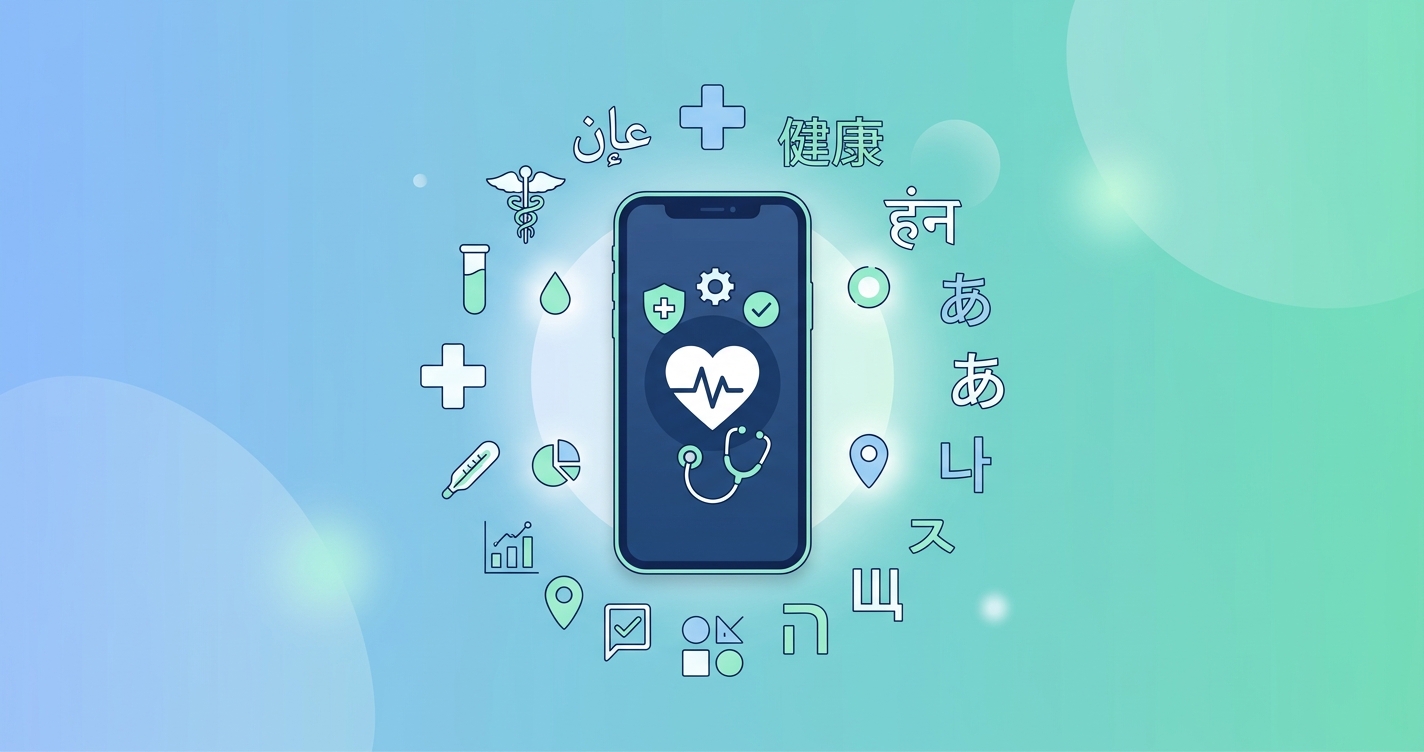
Roughly 25 million people in the United States have limited English proficiency, according to the Migration Policy Institute. That's 9% of the population. For life and health insurers, each of those individuals represents a potential applicant who may never complete an application because the health screening step wasn't available in their language. Multilingual health screening for global insurance markets isn't a diversity initiative or a checkbox exercise. It's a distribution problem, and carriers who solve it first will write policies their competitors can't.
A 2024 analysis by the Commonwealth Fund found that as many as one in four uninsured individuals in the U.S. have limited English proficiency. In Medicaid dual-eligible populations, that ratio rises to one in five. The language gap in insurance isn't theoretical — it shows up in enrollment data every quarter.
Why language barriers kill insurance applications
Insurance applications are already friction-heavy: lengthy forms, medical terminology, scheduling requirements. Adding a language barrier on top of that makes abandonment almost inevitable. LIMRA's research has consistently shown that complex application processes drive drop-off, and language compounds every friction point.
Consider the typical health screening workflow. An applicant receives instructions (in English), schedules an exam (through an English-speaking coordinator), answers health history questions (in English), and receives follow-up communications (also in English). For a Spanish-speaking applicant in Houston or a Mandarin-speaking applicant in San Francisco, each of those touchpoints is a potential exit point.
The regulatory environment is tightening around this problem. Title VI of the Civil Rights Act and Section 1557 of the ACA require meaningful language access for health-related services. A 2023 survey by the National Health Law Program cataloged language access provisions across all 50 states, finding that California alone has 257 separate statutory provisions addressing language needs in healthcare contexts. Insurers operating in these states face compliance risk if their screening processes don't accommodate LEP applicants.
| Factor | English-only screening | Multilingual digital screening |
|---|---|---|
| Applicant pool reach | Limited to English-proficient population | Expands to full demographic, including 25M+ LEP individuals in the U.S. |
| Application completion rate | Lower for LEP applicants due to comprehension barriers | Higher — instructions, questions, and results in preferred language |
| Regulatory compliance | Risk of Title VI / Section 1557 violations in many states | Built-in compliance with federal and state language access requirements |
| Scheduling friction | Requires bilingual examiners or interpreters, adding delay | Self-service digital flow eliminates interpreter scheduling |
| Cost per screening | Higher when interpreter services are needed ($150-300/session) | Lower — automated translation built into the platform |
| Geographic scalability | Constrained by local bilingual examiner availability | Available anywhere with smartphone access |
| Data consistency | Variable when interpreted through third parties | Standardized — same validated questions across all languages |
How digital screening changes the math on multilingual access
Traditional paramedical exams in multiple languages meant hiring bilingual nurses or booking interpreters. That was expensive and logistically painful. A bilingual paramedical exam in a less common language — Vietnamese, Tagalog, Haitian Creole — could take weeks to coordinate and cost three to four times the standard rate.
Digital health screening changes this equation. When the screening happens on a smartphone, the interface, instructions, and health questionnaire can all be rendered in the applicant's preferred language without any human translator in the loop. Camera-based biometric measurements (heart rate, respiratory rate, blood pressure estimates) don't require language at all — the applicant just looks at the screen.
This is where the economics get interesting. According to a 2023 report published in Frontiers in Digital Health by researchers at the University of Lisbon, multilingual functionality in national health applications reduced dropout rates among non-native speakers by 34% in pilot programs across Portugal and France. The same principle applies to insurance screening: remove the language barrier and more people finish the process.
The U.S. market opportunity
The Migration Policy Institute's data breaks LEP populations down by language. Spanish speakers account for the largest share at roughly 16 million, followed by Chinese (including Mandarin and Cantonese) at approximately 1.6 million, Vietnamese at around 800,000, Korean at roughly 500,000, and Tagalog at a similar number. Each of these populations has distinct geographic concentrations: Spanish in Texas, California, and Florida; Chinese in New York and California; Vietnamese in Texas and California.
For a carrier launching a multilingual screening program, the priority list writes itself. Supporting Spanish alone covers more than 60% of the LEP population. Adding Chinese, Vietnamese, Korean, and Tagalog gets you past 80%.
International expansion
Outside the U.S., the calculus is different but the principle is the same. A carrier expanding into Southeast Asia, Sub-Saharan Africa, or South America needs screening tools that work in local languages and dialects. The WHO's multilingualism policy framework emphasizes that health information must reach people in languages they understand, and that principle extends to any health-adjacent service, including insurance screening.
India alone has 22 official languages. Indonesia has over 700 local languages with Bahasa Indonesia as the lingua franca. A digital screening platform that supports the top 15-20 languages globally can serve markets that would have been operationally impossible with examiner-based models.
What carriers actually need in a multilingual screening platform
Not all multilingual implementations are equal. A bad translation of a health questionnaire can be worse than no translation at all — medical terminology that's mistranslated can lead to incorrect health disclosures, which creates underwriting risk.
The baseline requirements for a production-grade multilingual health screening system:
- Clinically validated translations of all health questionnaire content, not machine translation
- Cultural adaptation beyond literal translation — question framing that makes sense in the target culture
- Right-to-left language support for Arabic, Hebrew, and Urdu interfaces
- Audio instructions for populations with lower literacy rates
- Biometric measurement interfaces that require minimal text comprehension
- Regulatory compliance documentation for each supported language and jurisdiction
Providertech's 2025 research on multilingual healthcare support noted that healthcare organizations serving diverse populations saw measurable improvements in patient engagement when communications were delivered in preferred languages, with some programs reporting 40% higher response rates for outreach in the patient's primary language versus English-only communication.
Current research and evidence
There's a deep body of research on language barriers in healthcare, and it all says roughly the same thing: when patients get care in their own language, outcomes improve.
A systematic review published in BMC Health Services Research examined 33 studies on language barriers in healthcare access. The review found that LEP patients were significantly less likely to have a regular healthcare provider, less likely to receive preventive services, and more likely to report poor self-rated health. These patterns map directly onto insurance contexts — the same populations that struggle to access healthcare also struggle to complete insurance applications.
Research from the KFF (Kaiser Family Foundation) has documented that LEP status correlates with higher uninsured rates across all racial and ethnic groups. Among Hispanic nonelderly individuals, those with LEP have the highest uninsured rate of any demographic segment. That's not a demand problem. The systems just weren't built for them.
The National Health Law Program's 50-state survey of language access laws found enormous variation in requirements. Some states have comprehensive frameworks; others have almost nothing. Georgia, for example, has only 3 language access provisions in its health-related statutes, compared to California's 257. Carriers operating across multiple states need screening platforms that can adapt to this patchwork of requirements.
The future of multilingual insurance screening
A few things are pushing multilingual screening adoption forward. AI-powered translation has gotten good enough to produce clinically acceptable output for most major languages, though human validation is still necessary for medical content. Camera-based biometric screening reduces how much text the applicant needs to read in the first place, since physiological measurements don't depend on language comprehension. And regulatory pressure from CMS, state insurance departments, and international bodies keeps ratcheting up language access requirements.
For carriers and MGAs evaluating their screening technology stack, the question isn't whether to support multiple languages — that's becoming table stakes. The question is whether to build language support as an afterthought or architect it in from the beginning. Retrofitting multilingual support onto a screening platform that was designed English-first is expensive and usually produces a worse experience than platforms built with internationalization as a core design principle.
Frequently asked questions
How many languages should an insurance screening platform support?
For U.S.-focused carriers, supporting Spanish covers the majority of the LEP population. Adding Chinese, Vietnamese, Korean, and Tagalog reaches over 80% of LEP individuals. For international deployment, the top 15-20 languages by speaker population cover most addressable markets.
Does multilingual screening affect underwriting accuracy?
When translations are clinically validated and culturally adapted, there should be no difference in data quality compared to English-language screening. The risk comes from poor or machine-only translations that lead to misunderstood health questions. Carriers should require validation documentation for each supported language.
What regulations require multilingual health screening?
In the U.S., Title VI of the Civil Rights Act and Section 1557 of the ACA require meaningful language access for federally funded health services. State requirements vary widely — California has 257 language access provisions while some states have fewer than 10. Insurance-specific requirements are set by state departments of insurance and vary by jurisdiction.
How does camera-based screening help with language barriers?
Camera-based biometric measurements like heart rate, respiratory rate, and blood pressure estimation require minimal text interaction. The applicant follows simple visual cues on screen. This reduces the amount of content that needs translation and makes the screening accessible to individuals with lower literacy levels in any language.
Solutions like Circadify are building multilingual, camera-based health screening directly into the digital application flow, making it possible for carriers to reach applicant populations that traditional screening methods simply can't serve. As LEP populations grow domestically and carriers push into new international markets, the language question will only get louder.
If you're evaluating how digital health assessments fit into your underwriting workflow, or exploring how mobile screening reaches rural and remote applicants, the language dimension is worth factoring in from day one.