What Is a Remote Paramedical Exam? How Self-Scan Technology Compares
Comparing remote paramedical exams with self-scan technology for life insurance underwriting, including cost, speed, applicant experience, and data quality.
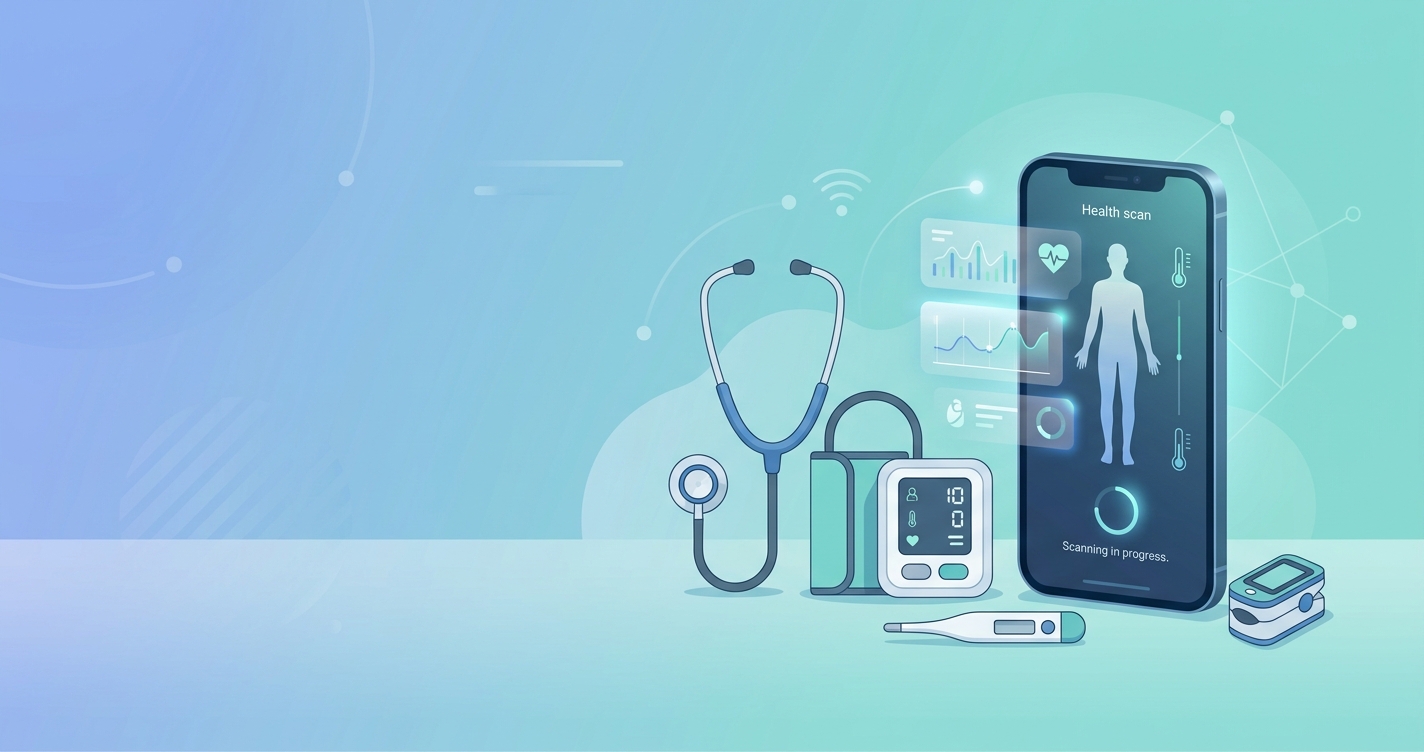
The remote paramedical exam has been the insurance industry's attempt to modernize a process that hasn't changed much since the 1980s. Instead of sending a nurse to the applicant's home, the exam happens over video or at a nearby clinic with telehealth oversight. It was a reasonable first step. But self-scan technology — where applicants capture their own vital signs using a smartphone camera — is forcing carriers to ask whether the remote paramedical exam is actually the endpoint, or just a waypoint.
LIMRA's 2024 cost benchmarking study reported that traditional paramedical assessments cost carriers between $80 and $150 per applicant, while digital self-scan alternatives run $2 to $8 per assessment. That gap is hard to ignore at scale.
How a remote paramedical exam actually works
A remote paramedical exam keeps the core structure of the traditional exam but removes the in-person visit. The applicant schedules an appointment with a licensed examiner who connects via video. In some programs, the applicant visits a retail clinic or lab location. Blood and urine samples are either self-collected with a mailed kit or drawn at a nearby facility. The examiner observes the process, records vitals (blood pressure, pulse, height, weight), and submits everything to the underwriting team.
This model gained traction during 2020 when in-home visits became impractical. ExamOne, one of the largest paramedical exam providers in the U.S., expanded its remote scheduling and text-based communication tools to reduce no-show rates. Several carriers adopted hybrid programs where low-risk applicants could complete abbreviated exams remotely while higher-risk cases still required full in-person assessments.
The remote exam solves the scheduling problem. It doesn't solve the cost problem, the speed problem, or the scalability problem. A licensed examiner still has to be present. Lab work still takes days. And the applicant still has to block off 30 to 45 minutes for the appointment.
Self-scan technology: what it is and isn't
Self-scan technology uses remote photoplethysmography (rPPG) to extract cardiovascular data from facial skin. The applicant opens a link on their phone, faces the camera for 30 to 60 seconds, and the software reads subtle color changes caused by blood flow beneath the skin. From that signal, the system derives heart rate, heart rate variability, respiratory rate, blood oxygen estimates, and in some implementations, blood pressure estimates.
A clinical validation study published in PMC in 2025 evaluated rPPG-enabled contactless pulse rate monitoring in cardiovascular disease patients and found strong agreement with traditional monitoring methods. The WellFie study (medRxiv, 2023) reported heart rate prediction accuracy of 97.34% and respiratory rate accuracy of 84.44% against clinical reference standards. De Ridder et al., writing in Frontiers in Physiology (2025) and reviewing 96 studies on rPPG health assessment, confirmed that the core heart rate extraction technology is well established.
What self-scan technology does not do: it doesn't draw blood. It can't run a lipid panel or an A1C test. It doesn't check for nicotine metabolites. For underwriting programs that require fluid biomarkers, self-scan technology replaces the vitals capture portion of the exam, not the lab work.
Side-by-side comparison
The differences between these two approaches aren't subtle. They affect different parts of the underwriting operation in different ways.
| Factor | Remote paramedical exam | Self-scan technology (rPPG) |
|---|---|---|
| Cost per assessment | $80–$150 (LIMRA 2024) | $2–$8 per scan |
| Time to complete | 30–45 minutes scheduled appointment | 30–60 seconds, no appointment |
| Data available | Vitals + blood/urine labs | Vitals only (HR, HRV, RR, SpO2, BP estimate) |
| Applicant scheduling | Required — examiner must be present | None — applicant scans on their own time |
| Lab turnaround | 3–7 business days | Instant results |
| Examiner required | Yes, licensed professional | No |
| Scalability | Limited by examiner availability | Unlimited — software-based |
| Applicant completion rate | 70–80% (industry average) | 85–95% (carrier-reported) |
| Geographic reach | Limited to examiner/clinic network | Anywhere with a smartphone |
| Fraud detection | Examiner observes in real time | Liveness detection via rPPG signal |
For carriers processing high volumes of low-face-amount policies — term life under $500K, group voluntary, or direct-to-consumer products — the economics of remote paramedical exams don't work. The exam costs more than the first year's premium on many of these policies.
Where remote paramedical exams still make sense
Writing off the remote paramedical exam entirely would be a mistake. There are underwriting scenarios where it remains the right tool.
High-face-amount policies
When the face amount exceeds $1 million, carriers need more than screening-level vitals. Full blood panels, urine analysis, and sometimes EKGs are standard requirements. The mortality risk at these coverage levels justifies the per-assessment cost. A remote paramedical exam with lab work provides data that self-scan technology simply cannot replicate.
Rated or substandard cases
Applicants flagged during initial triage — those with disclosed health conditions, medication histories, or abnormal screening results — often need traditional lab evidence. The remote exam serves as the escalation path for cases that self-scan screening identifies as needing deeper investigation.
Regulatory requirements
Some state insurance regulations and reinsurance treaties still specify paramedical evidence for certain product types or coverage bands. Until those requirements update, carriers need to maintain exam capabilities.
Where self-scan technology wins outright
Accelerated underwriting triage
The original promise of accelerated underwriting was speed: get the policy issued in days instead of weeks. LIMRA reported that three out of four U.S. and Canadian life insurance companies now operate some form of accelerated or automated underwriting program. Self-scan technology fits directly into these workflows. The applicant completes the scan during the application itself, and the vitals data feeds immediately into the underwriting rules engine.
Munich Re's research on accelerated underwriting during the post-2020 period noted that programs combining multiple data sources — including digital health assessments — could reduce paramedical exam orders by over 40% without materially affecting mortality experience.
Direct-to-consumer and embedded insurance
Products sold through digital channels need digital evidence collection. Asking someone who just clicked "Get a Quote" on a website to schedule a paramedical exam three days later breaks the conversion funnel. Self-scan technology keeps the applicant in the same session. They answer health questions, scan their face, and receive a decision — all in one sitting.
Group and voluntary benefits enrollment
Open enrollment periods are compressed. Benefits administrators need to process thousands of enrollees in weeks. Routing each applicant through a paramedical exam, even a remote one, creates a logistics bottleneck. Self-scan screening handles volume without infrastructure constraints.
Data quality considerations
Carriers evaluating self-scan technology ask a reasonable question: is a 60-second camera scan really comparable to a nurse taking vitals with medical-grade equipment?
The honest answer is that it depends on what you're measuring and what you're using it for. For heart rate and heart rate variability, the research is solid. The hospital-based trial published in PMC (Journal of Clinical Medicine, 2022) by Ille et al. demonstrated that rPPG could remotely measure respiratory rate with acceptable accuracy compared to reference devices in a clinical setting.
Blood pressure estimation through rPPG remains less precise than cuff-based measurement. The WellFie study found systolic blood pressure prediction error of 6.06% and diastolic error of 7.05% — within reasonable screening ranges, but not at the level a carrier would use for rated-case decisions.
The practical takeaway: self-scan vitals are accurate enough to triage applicants into accelerated pathways. They are not a replacement for clinical-grade measurement when the underwriting decision hinges on precise blood pressure or lab values.
The hybrid model most carriers are moving toward
The either/or framing is misleading. Most carriers implementing self-scan technology aren't eliminating paramedical exams. They're using self-scan as the first layer in a tiered evidence strategy.
The pattern looks like this: every applicant completes a self-scan during the application. The vitals data, combined with prescription history (Rx checks), motor vehicle records, and MIB data, feeds into the underwriting rules engine. Applicants who pass all thresholds get an accelerated decision — no exam needed. Applicants who trigger a flag get routed to a remote paramedical exam or full traditional exam.
This approach reduces total exam volume (and cost) while maintaining underwriting rigor for higher-risk cases. The self-scan acts as a filter, not a replacement.
Current research and evidence
The research base for camera-based vital sign monitoring continues to grow. A few studies worth tracking:
The PMC clinical validation study (2025) on rPPG-enabled contactless pulse rate monitoring specifically targeted cardiovascular disease patients, a population where measurement accuracy matters most. The results showed strong correlation with traditional monitoring.
Ille et al.'s hospital-based trial (PMC, 2022) demonstrated rPPG respiratory rate measurement accuracy in a controlled clinical environment, providing evidence that the technology works beyond healthy volunteer populations.
The WellFie study (medRxiv, 2023) remains one of the most comprehensive smartphone-based rPPG evaluations, covering heart rate, respiratory rate, and blood pressure across a diverse subject pool varying in age, height, weight, and skin tone.
De Ridder et al.'s systematic review (Frontiers in Physiology, 2025) synthesized 96 rPPG studies and confirmed that while heart rate extraction is mature, research is now focused on real-world robustness — varied lighting conditions, movement artifacts, and diverse skin tones.
The future of insurance health screening
The trajectory is clear even if the timeline isn't. Self-scan technology handles the majority of screening-level assessments today. As measurement precision improves — particularly for blood pressure and blood oxygen — the percentage of applicants who need any form of paramedical exam will continue to shrink.
Carriers that build their underwriting architecture around a tiered model now will be positioned to reduce exam volumes further as the technology matures. Those still routing every applicant through a paramedical exam, remote or otherwise, are paying a premium for evidence collection that often doesn't change the underwriting outcome.
Companies like Circadify are working on this problem directly, building rPPG-based self-scan technology designed for insurance underwriting workflows. You can learn more at circadify.com/industries/payers-insurance.
Frequently asked questions
Can a self-scan replace a paramedical exam entirely?
For many low-to-moderate risk applicants, yes. Self-scan technology captures the cardiovascular vitals that underwriting engines need for triage decisions. But for cases requiring blood work, urine analysis, or clinical-grade blood pressure measurement, a paramedical exam — remote or traditional — remains necessary. The two approaches work best together in a tiered evidence model.
How accurate is rPPG-based vital sign measurement?
Clinical studies show heart rate accuracy above 97% compared to reference devices (WellFie study, medRxiv 2023). Respiratory rate accuracy is around 84%. Blood pressure estimation is less precise, with error rates of 6-7%, which is acceptable for screening but not for rated-case decisions. Accuracy continues to improve as algorithms advance.
Do applicants trust self-scan technology?
Carriers using self-scan screening report completion rates between 85% and 95%, compared to 70-80% for scheduled paramedical exams. The lower friction — no appointment, no waiting, no needles — drives higher engagement. Applicants generally prefer scanning their face for 30 seconds over scheduling a medical appointment.
What happens if the self-scan results are borderline?
Most carriers route borderline cases to traditional evidence collection. If the self-scan vitals fall outside normal ranges or trigger underwriting rules, the applicant is referred for a remote paramedical exam, lab work, or attending physician statement. The self-scan serves as the initial screen, not the final word.