
Smartphone Vitals vs Lab Panels: What Insurers Should Know
How smartphone-based vital sign screening compares to traditional lab panels for insurance underwriting, with cost, speed, and accuracy analysis.
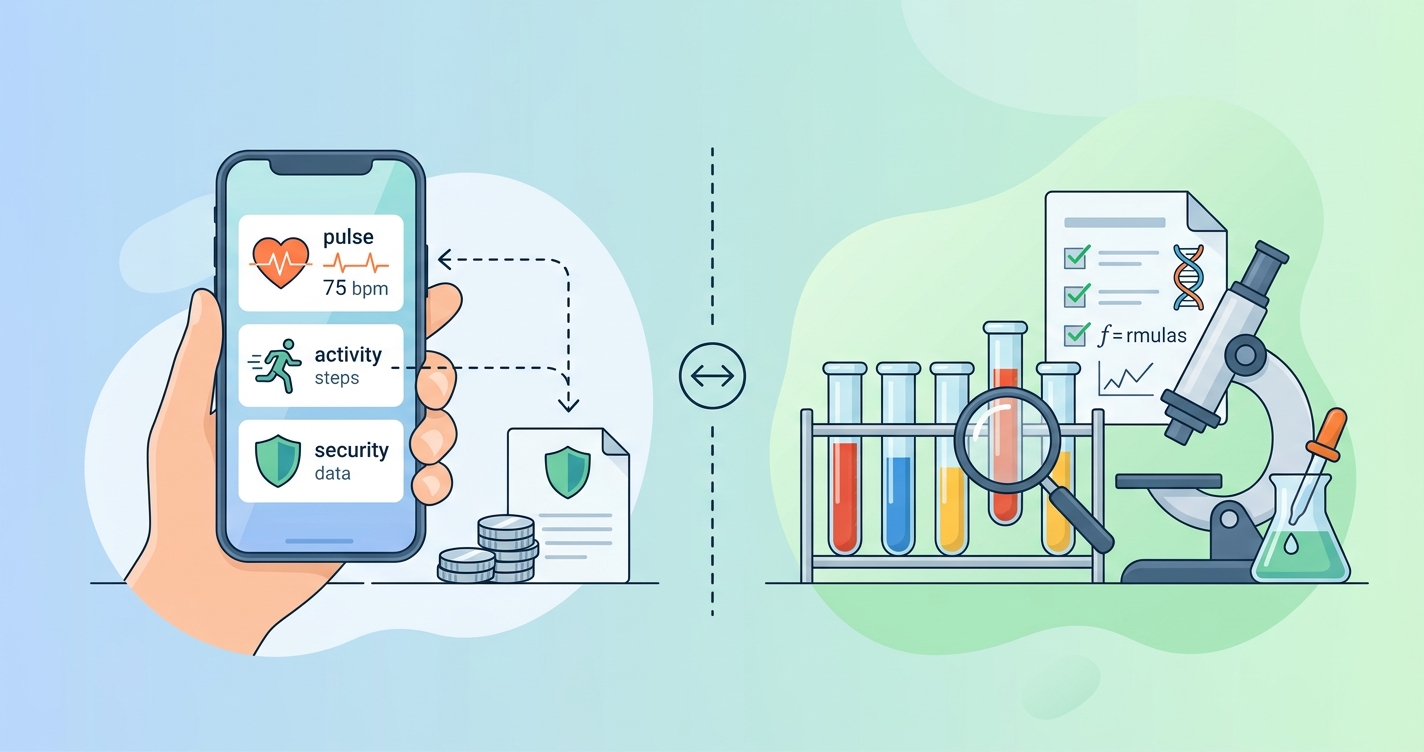
The insurance industry has spent decades relying on the same evidence-gathering toolkit: blood draws, urine samples, and paramedical exams conducted by visiting nurses. These lab panels have served underwriters well. They catch metabolic disorders, flag substance use, and provide a biochemical snapshot that rating tables were built around. But smartphone-based vital sign screening has reached a point where insurers need to seriously evaluate what each method actually contributes to underwriting decisions, and at what cost.
A 2025 study in the North American Actuarial Journal (Vol. 28, No. 1) tracked mortality experience across 47 carriers using digital health screening tools and found no statistically significant difference in mortality outcomes compared to carriers relying on traditional paramedical evidence for policies under $500,000.
What smartphone vitals actually measure vs lab panels
This is not an apples-to-apples comparison. Smartphone vitals and lab panels measure different categories of health data, and the overlap between them is narrower than most people in the industry assume.
Lab panels measure biochemical markers in blood and urine: lipid profile, glucose, liver enzymes, kidney function markers, cotinine (nicotine metabolite), and sometimes HbA1c. Direct chemical measurements. Organ function, metabolic health, substance exposure.
Smartphone-based vital sign screening uses remote photoplethysmography (rPPG) to capture cardiovascular metrics through a phone camera. A 30 to 60-second facial scan extracts heart rate, heart rate variability, respiratory rate, blood oxygen saturation, and estimated blood pressure. Physiological measurements. Cardiovascular function and autonomic nervous system health.
Both methods assess cardiovascular risk, but from different angles. Lab panels catch dyslipidemia and elevated glucose. Smartphone vitals catch elevated resting heart rate and blood pressure. Neither alone gives you the full picture.
| Factor | Smartphone vitals (rPPG) | Traditional lab panels |
|---|---|---|
| What's measured | Heart rate, HRV, respiratory rate, SpO2, blood pressure estimate | Lipid profile, glucose, liver enzymes, kidney markers, cotinine |
| Collection time | 30-60 seconds, self-administered | 15-30 minutes with scheduled nurse visit |
| Applicant experience | Phone camera scan from home, any time | Scheduled appointment, needle stick, fasting required |
| Cost per assessment | $5-15 | $100-150 per paramedical exam |
| Turnaround time | Instant results | 3-7 business days for lab processing |
| Cardiovascular risk signal | Direct hemodynamic measurement | Indirect via lipid and metabolic markers |
| Substance detection | Not capable | Cotinine, THC, cocaine metabolites |
| Repeat measurement | Easy and cheap to retest | Expensive and logistically complex |
| Applicant completion rate | 85-95% (industry estimates) | 60-75% (LIMRA data) |
| Fraud/gaming potential | Difficult to fake a pulse signal | Possible to temporarily alter some markers |
The cost math behind adoption
The economics are straightforward. According to industry data from LIMRA and individual carrier disclosures, the average paramedical exam costs between $100 and $150 when you factor in the nurse visit, specimen collection, lab processing, and shipping. For a carrier processing 100,000 applications per year, that represents $10 to $15 million in evidence-gathering costs annually.
Smartphone-based screening costs a fraction of that. Even at the higher end of vendor pricing, digital health assessments run $10 to $15 per completed scan. The savings aren't just on unit cost. Carriers also save on the paramedical exams that never happen because the applicant drops out. LIMRA's 2024 insurance barometer study found that 25% of applicants who begin a life insurance application abandon it before completion, and the paramedical exam is cited as one of the primary friction points.
RGA's research on digital underwriting evidence has shown that carriers using digital health screening in their accelerated underwriting programs can identify a significant pool of applicants who qualify for instant or expedited decisions without any lab work. The remaining applications that do need labs can be triaged more efficiently because the initial screen narrows the population.
Where labs still win
Labs have clear advantages in specific underwriting scenarios that smartphone vitals cannot replicate:
- Detecting nicotine use through cotinine testing, which remains one of the most consequential rating factors in life insurance
- Identifying undiagnosed diabetes through elevated glucose or HbA1c
- Catching liver disease via elevated ALT and AST enzymes
- Detecting kidney dysfunction through creatinine and BUN levels
- Substance use screening for cocaine, marijuana, and other drugs
For high face-amount policies where the insurer's exposure justifies thorough evidence, lab panels provide information that no camera-based tool can match. The question is whether every $250,000 term policy actually needs that level of scrutiny.
Where smartphone vitals add something new
Smartphone vitals also provide data that lab panels never could:
- Resting heart rate measured in a natural setting rather than during an anxiety-inducing medical exam
- Heart rate variability, which research from the Kailuan Study (Wang et al., 2014, following 92,562 participants) and the Melbourne Collaborative Cohort Study (Seviiri et al., 2017, tracking 21,692 participants over 22 years) has linked to all-cause mortality
- Respiratory rate, which is almost never captured in paramedical exams but correlates with cardiac risk
- The ability to take multiple readings over time, building a more reliable baseline than a single point-in-time measurement
A meta-analysis by Aune et al. (2017), covering 87 studies and 1.8 million participants, found that each 10 beat-per-minute increase in resting heart rate was associated with a 17% increase in all-cause mortality risk. That is a meaningful underwriting signal that traditional paramedical exams capture poorly because of white coat effects. (For a deeper look at how each vital sign maps to mortality risk, see our primer on vital signs and underwriting risk.)
Accuracy: what the validation studies show
The accuracy question is the one that actuaries and chief underwriting officers ask first, and the research has matured considerably.
A validation study published on medRxiv (2023) enrolled 150 normotensive adults and compared smartphone-based rPPG measurements against clinical reference devices. The study used machine learning algorithms to predict systolic and diastolic blood pressure, heart rate, and respiratory rate from smartphone camera data. Heart rate measurements showed the strongest correlation with reference values, while blood pressure estimates showed promising but wider confidence intervals.
Shoushan et al. achieved 99.4% accuracy for rPPG-based heart rate measurement from smartphone and laptop cameras, as reported in a review published in Frontiers in Digital Health (2025). SpO2 measurements from the same platforms showed similar accuracy levels for health assessment applications.
These accuracy numbers carry an important caveat. Lab panel accuracy is a different kind of measurement. A lipid panel tells you a precise cholesterol number. A smartphone heart rate reading tells you a precise pulse number. The question for underwriters is not which number is more accurate to its reference standard but which number is more predictive of the mortality risk they are trying to price.
The tiered evidence model
Most carriers adopting smartphone vitals are not replacing lab panels entirely. They are building tiered evidence models where the screening method matches the risk exposure.
The emerging industry pattern looks something like this:
| Policy tier | Face amount | Evidence gathered | Rationale |
|---|---|---|---|
| Tier 1: Instant issue | Under $100K | MIB, Rx check, digital health screen | Low exposure; speed and completion rate matter most |
| Tier 2: Accelerated | $100K-$500K | Tier 1 + smartphone vitals + EHR data | Moderate exposure; digital evidence sufficient for most healthy applicants |
| Tier 3: Simplified full | $500K-$1M | Tier 2 + targeted lab panel if flagged | Higher exposure; labs triggered only when digital screen raises questions |
| Tier 4: Traditional full | Over $1M | Full paramedical + labs + APS as needed | Maximum exposure; full evidence justified by risk |
This model lets carriers reserve expensive lab panels for cases where the financial exposure warrants them while using faster, cheaper digital screening for the majority of applications. RGA's analysis suggests that 40-60% of applications in the $250K-$500K range could be decisioned with digital evidence alone, depending on the carrier's risk appetite.
Current research and evidence
The research base for camera-based vital sign measurement is broader than it was even two years ago. The Frontiers in Digital Health review (2025) cataloged multiple validation studies across different rPPG platforms, finding that heart rate measurement has reached near-clinical accuracy in controlled conditions, with real-world accuracy improving as algorithms account for ambient lighting, motion artifacts, and skin tone variation.
RGA published research through their Knowledge Center on the mortality impact of digital underwriting evidence. Their data suggests that digital evidence programs can identify applicants who would be declined by traditional methods, meaning the technology catches risk signals that lab panels might miss, particularly cardiovascular indicators.
The UK Biobank has provided population-level evidence linking vital sign measurements to long-term mortality outcomes. Wang et al. (2026) found that walking pace was the strongest single predictor of mortality in the UK Biobank population, stronger than any individual lab marker. While walking pace is self-reported, the broader finding reinforces that physiological measurements carry predictive weight that complements biochemical data.
Where insurance health evidence is heading
Hybrid evidence models will probably be standard within three to five years. Lab panels are not disappearing, but their role is narrowing to higher-risk, higher-face-amount cases and targeted follow-up when digital screening raises a flag.
Applicant expectations have changed. People who deposit checks, file taxes, and see a doctor from their phone are not going to schedule a nurse visit and fast for a blood draw to buy a $300,000 term policy. Carriers offering a simpler application process are seeing measurably higher completion rates.
The actuarial evidence is building. As carriers accumulate mortality experience on digitally underwritten policies, the data will either validate or challenge assumptions about which evidence types matter most. The North American Actuarial Journal study's early findings suggest digital evidence holds up well for standard risk classes at moderate face amounts.
Companies like Circadify are building smartphone-based vital sign screening for insurance underwriting workflows, giving carriers a way to capture cardiovascular health data without the cost and delays of traditional paramedical exams.
Frequently asked questions
Can smartphone vitals completely replace lab panels for insurance underwriting?
Not for all cases. Smartphone vitals measure cardiovascular and respiratory function but cannot detect biochemical markers like cholesterol, glucose, or substance metabolites. The practical answer is that smartphone vitals can replace labs for a significant portion of applications, particularly at lower and moderate face amounts, while labs remain appropriate for high-exposure cases or when the digital screen raises concerns that warrant biochemical investigation.
How accurate are smartphone-based vital sign measurements compared to medical devices?
Heart rate measurement via rPPG has reached near-clinical accuracy, with studies reporting correlations above 99% against reference devices in controlled settings. Blood pressure estimation is less precise, with wider confidence intervals than a clinical cuff reading. The accuracy gap narrows with improved algorithms and controlled measurement conditions, and multiple readings over time can compensate for single-measurement variability.
What do reinsurers think about digital health screening replacing traditional evidence?
Major reinsurers including RGA have published research supporting the use of digital underwriting evidence, particularly in accelerated underwriting programs. Their analysis suggests that mortality outcomes on digitally underwritten policies are comparable to traditionally underwritten policies within appropriate face amount bands. Reinsurers generally support tiered evidence models where digital screening handles lower-risk tiers and traditional evidence is reserved for higher exposures.
How does applicant completion rate differ between smartphone screening and paramedical exams?
Digital health screening consistently achieves higher completion rates than paramedical exams. A smartphone assessment takes under a minute from the applicant's home, which eliminates the scheduling friction and needle anxiety that cause many people to abandon the process. The gap is widest among younger applicants and in the middle-market segment, where the policy economics make chasing down reluctant applicants for a nurse visit impractical.